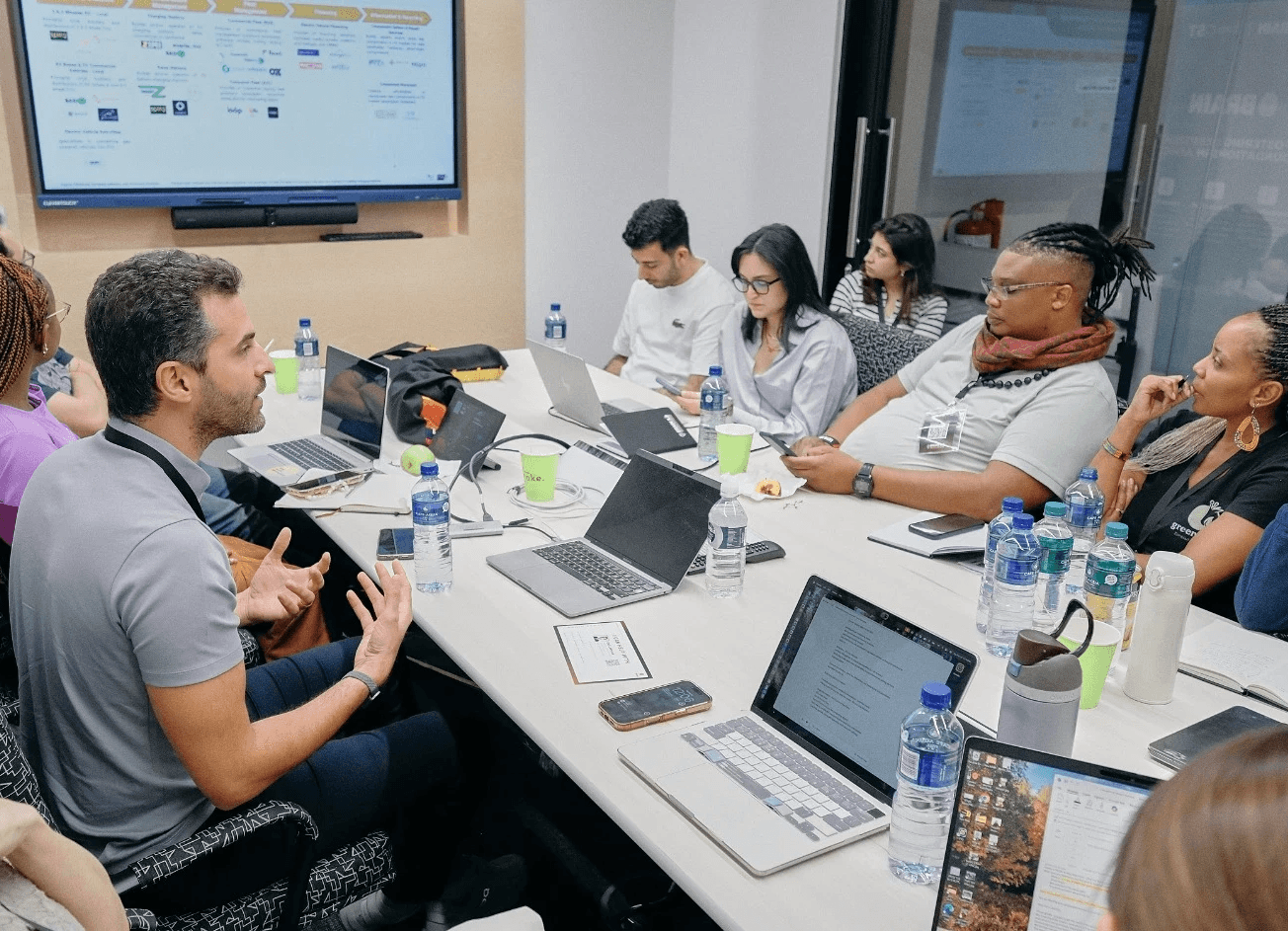
During a recent BRAIN session hosted with OST, founders stepped into an investor’s mindset—learning how climate and sustainability markets are evaluated, how funds build conviction, and how to translate a strong mission into an investable story. The session combined a candid market overview with live, interactive founder feedback, giving startups both strategic context and practical next steps to strengthen their go-to-market and fundraising readiness.
A candid view from the investor seat
The session opened with an inside look at how an Africa-focused investment platform approaches venture investing, pulling founders out of the pitch mindset and into the investor’s seat.
Rather than talking about what should be funded, Dali Lakhoua, VC Investment Officer with AfricInvest Group, walked through how capital is actually deployed, demonstrating an Africa-focused investment platform that takes a highly intentional approach. Instead of spreading bets widely, participants learned how the fund concentrated on a small number of companies and then worked alongside them—unlocking commercial traction, leveraging portfolio synergies, and pushing for execution that can scale in the real world. For founders, it was a rare chance to see what commitment looks like from the other side of the table—and what it takes to earn it.
With that lens in place, startups dived into how investors make sense of the climate landscape. Climate tech isn’t viewed as a single market, but as a set of interconnected systems: energy and decentralized grids, mobility and EV ecosystems, buildings and materials, agriculture and food value chains, waste, and carbon technologies. What mattered wasn’t the labels themselves, but how each segment is evolving, where capital is flowing, and why Africa’s dynamics are beginning to diverge from global trends. Founders could see clearly where momentum is building—and where assumptions no longer hold.
The most powerful insight, however, was deceptively simple: big numbers and sweeping narratives don’t create conviction. Investors want to understand how your market actually works. Who pays? Who decides? Where does value get stuck? And which bottleneck are you uniquely positioned to remove?
As the facilitator put it bluntly: “Don’t try to be the ambassador of your country at the United Nations. Be business-focused and add value to the reader.”
For startups considering BRAIN, this session captured the heart of the program. It’s not about polishing slides or repeating familiar talking points. It’s about learning to see your business through the same lens as the people who decide whether it scales—and gaining the clarity to tell a story that holds up under real scrutiny.
What investors want to see in your deck
A core teaching moment centered on market mapping. The session walked founders through how funds build theses for their own LPs (limited partners) and why the same discipline improves startup storytelling.
Founders were encouraged to move beyond population growth or market-size headlines and instead show:
The value chain: who does what today, and how money, data, and risk move through the system
The bottleneck: exactly where friction, cost, delay, or compliance requirements break the chain
The buyer: who has budget and urgency (often not who you first assume)
The “why now”: regulation shifts, supply chain pressure, cost inflections, or adoption enablers
Credibility signals: pipeline, active discussions, proof of execution, and realistic path to scale
Building smart investor relationships (and avoiding dead ends)
The session also provided direct, founder-relevant guidance on navigating investor outreach—especially important as visibility increases and startups navigate the fundraising phases.
Key advice included:
Ask early if a fund is actively investing (and when they last deployed capital)
Do lightweight diligence on portfolio overlap (competitors, adjacent plays, conflicts)
Don’t ask for an NDA too early—it’s a red flag in early fundraising
Share what you’d be comfortable putting in a public post; save sensitive details for later-stage diligence
Always make an “ask” (introductions, relevant experts, distribution partners) and follow up on it
The message wasn’t to be cautious to the point of silence—rather it keeps conversations productive.
Why this matters—and why BRAIN at OST is different
What made this session distinctive was its realism. Founders didn’t just hear “tell a better story.” They learned how investors structure markets, what LP-grade thinking looks like, and why clarity beats complexity in every fundraising conversation. Then they immediately applied it under live feedback.
BRAIN programming at OST is designed to accelerate exactly this kind of founder growth: practical strategy, real-world market framing, and the confidence to engage partners, customers, and investors with credibility.
—
By Andrea Shepherd
MIT Sloan EMBA ‘26