Ancient Indian Scriptures declare “Vasudhaiva Kutumbakam” (in Sanskrit) meaning that the “Entire World itself is a Family”. In modern times, despite all the apparent superficial differences, we know that the world is deeply interconnected and activities in one region of the world influence and are influenced by events elsewhere.
When I was a medical student in the early 2000’s, I had come up with a ‘model’ of the kind of medicine I wanted to practice. It was about integrating paradigms and practices from ‘molecules to masses’, using ‘machines and mathematics’ with the individual human being at the center of it.
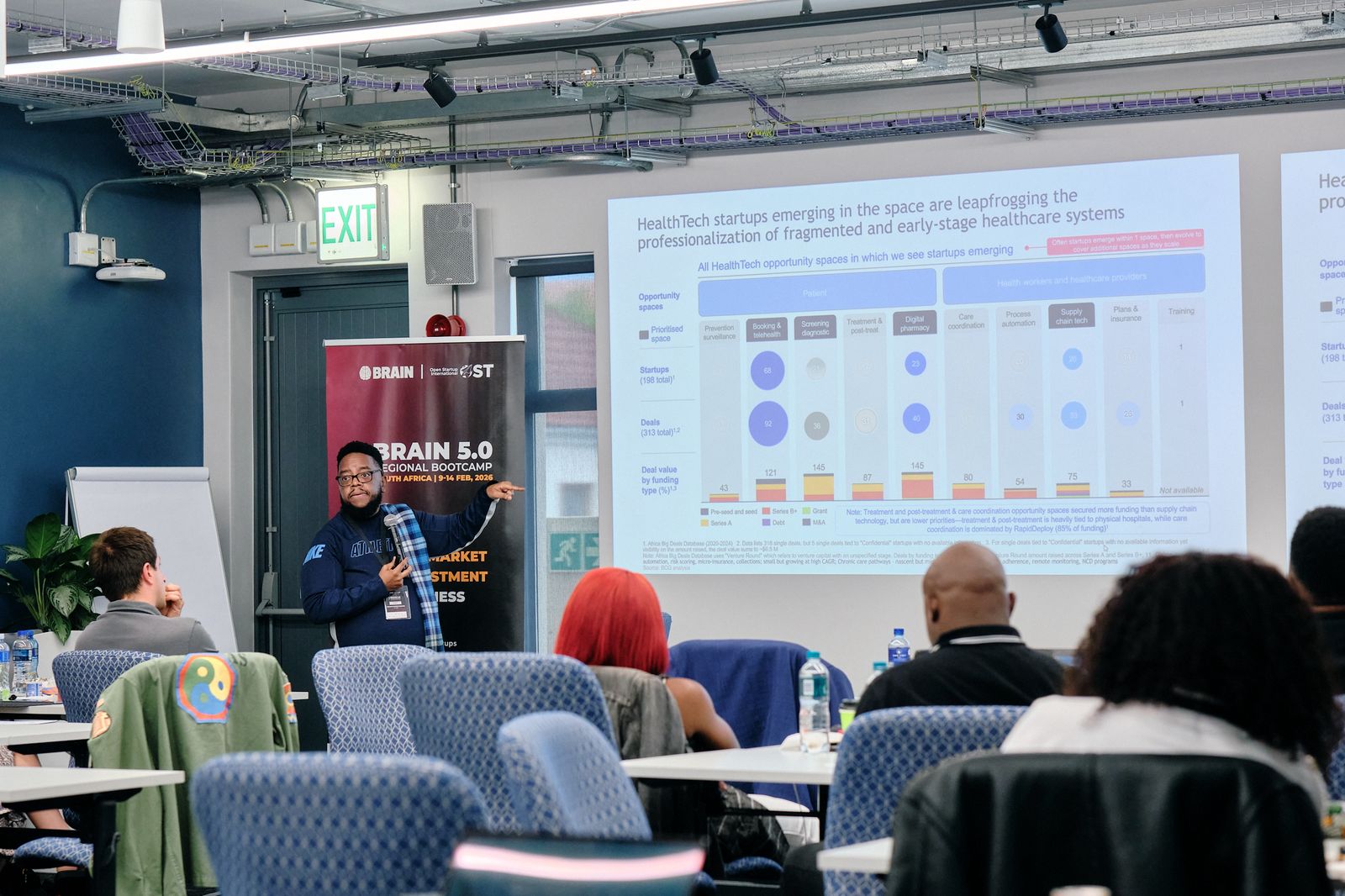
Thanks to MIT Sloan School of Management, Open Startup International, Stellenbosch University (South Africa) I had the privilege to become a part of a ‘mass’ level impact and extend my work beyond the clinic and translational research lab. I am privileged to be invited to participate in the BRAIN accelerator regional bootcamp in Cape Town, South Africa to support leading entrepreneurial startups in the African continent in the healthcare sector.
10 startups were selected from among 133 applications and will undergo a transformative experience during the Bootcamp, with support from the BRAIN team, MIT Executive MBA students, local and global experts! I have been inspired by the tremendous energy of the fantastic startups showcasing their work at the meeting and wish them well as they progress in their journey.
I had the opportunity to learn from the amazing Kisimbi Kyumwa Thomas about the market realities in the healthcare sector in Africa. It became deeply clear to me that while there were many challenges, these challenges posed equally exciting opportunities for entrepreneurial ventures in Africa.
Undoubtedly, there are significant heterogeneities in the regional entrepreneurial opportunities within Africa. Startup funding is concentrated in a few countries sometimes referred to as the ‘Big 4’: South Africa, Kenya, Nigeria and Egypt. Funding is most active in early stages of start ups, with equity being the most prevalent form of funding (as opposed to say, debt). However, there is a big gap in the middle stages of the ventures before they truly scale to very high levels.
Despite these gaps, HealthTech presents a compelling opportunity with a persistent burden of communicable diseases and a rising burden of non-communicable diseases in Africa. Supply chain constraints related to efficiency and costs and regulatory environment pose challenges but also provide opportunities for growth in the digital healthcare delivery sector. Key stakeholders are prioritizing virtual healthcare support, diagnostic and clinical decision support, care coordination and population health surveillance and entrepreneurial ventures are clearly growing across the continent.
Interestingly, ~77% of HeathTech market share clusters around the operations and support sector (~61%) and patient interaction (~16%), and ~22% belongs to medical journey applications, including prevention and surveillance, screening and diagnosis, treatment and post-treatment management. This distribution is remarkably similar to global trends.
It was inspiring to note that across telehealth, diagnostics, care coordination, supply chains, population health, and AI-enabled decision support, African innovators are not merely catching up, they are in many ways leapfrogging legacy healthcare models. Accessibility, affordability, regulatory clarity, reimbursement pathways, and real-world evidence, not just technology, will determine which ideas truly transform care.
Further, the session highlighted that funding initiatives that are tool-specific (e.g. Microsoft for AI) and have system-wide effects (e.g., WHO supported initiatives) are mutually reinforcing and will set the stage for further growth of African entrepreneurship.
In summary, Africa is not simply a market to enter. It is a laboratory for the future architecture of global health systems--where necessity, creativity, and systems-thinking converge to build scalable solutions for billions.
For those of us working at the intersection of clinical medicine, diagnostics, data, and entrepreneurship, the question is no longer whether transformation will happen…
…but who will build responsibly, collaboratively, and at scale.
Grateful to the organizers, speakers, and entrepreneurs driving this momentum.
The world should be paying close attention.
—
By Tarun Singhal, MD
MIT EMBA ‘26